Showing posts with label Indigo Japon. Show all posts

Thursday, 1 July 2010

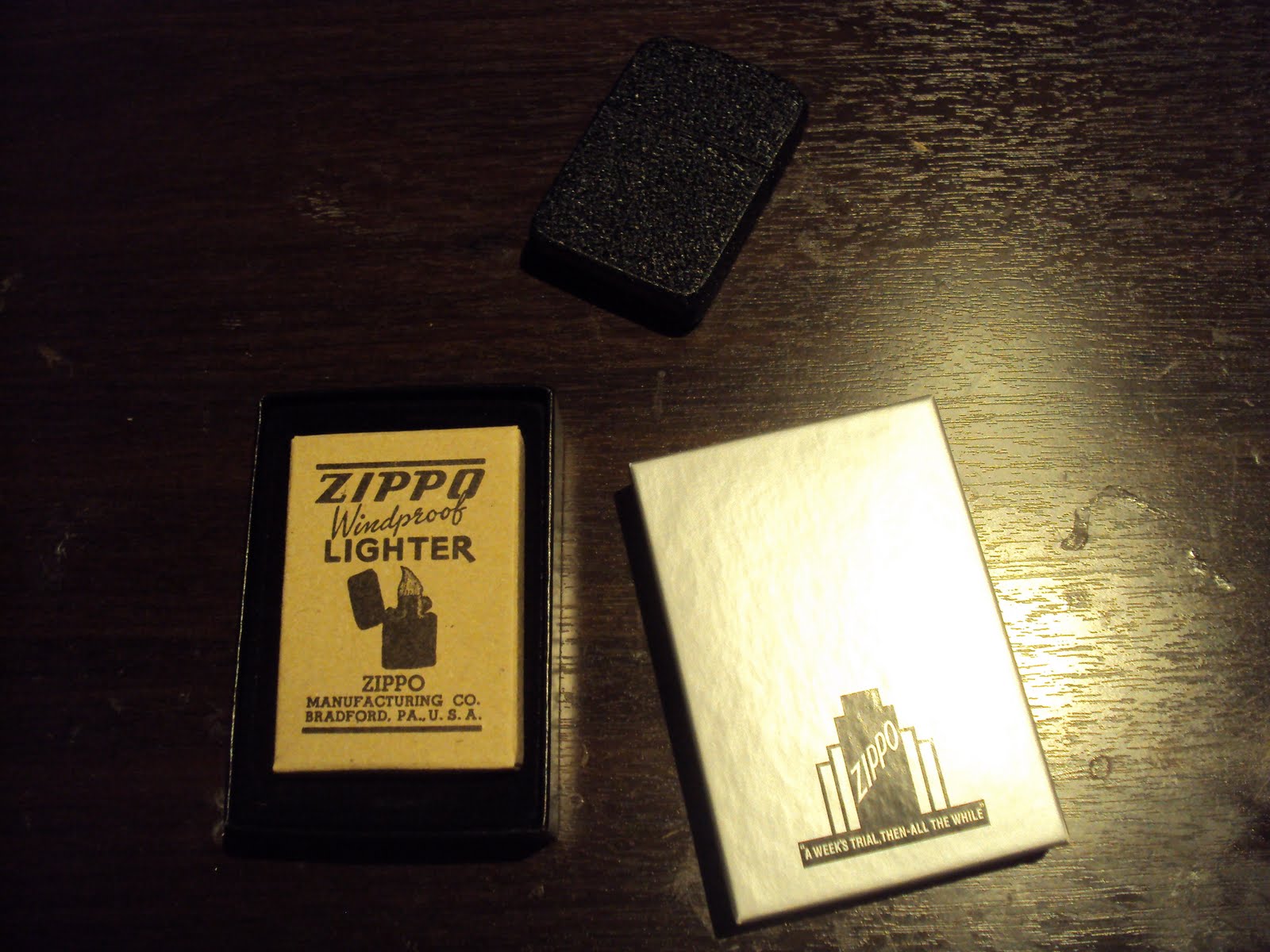
Zippo ~ WW2 1944 Black Crackle Replica


...scored this replica from eBay recently. I used it immediately of course, but little did I realise that the black crackle actually wears off pretty easily. Supposedly a replica from the original issued en masse to the American troops in WW2. The black crackle "paint" is actually applied not without a reason. Reduce cost due to resource conservation and scarcity during wartime period. Just like how the 501XX version 1944 has applied arcuate paints instead of stiching.


Saturday, 29 May 2010

Evisu No.1 Special ~ 20oz 20th Anniversary Version.


...the package arrived. Evisu No.1 Special in 20oz version. And I could not believe my eyes when Hide-san said over his email reply that yes, indeed it was still available. This is it. A nice, overall very satisfactory way to cap off 2010 denim purchase (err, the only pair btw for 2010, coz I missed The Flathead Lot 3005 re-issue with proper arcuates and red tab. I am seriously cutting down my denim budget...with newfound obsession over 1/6th plastique). Like mentioned before, I got this coz a) its an anniversary edition (I just couldn't wait another 10 years), b) it comes with a that cinch back ~ must be the "thickest" cinch I ever seen, just like what I seen previously on Yamane's Lot 1947. This is perhaps the lamest excuse I gave myself to get it (and subsequently burning larger and larger hole in the pocket). All characteristics of an Evisu are here as usual for a Made In Japon Evisu so I wouldn't wanna go through it again 'cept for a) the label is made of cloth instead of the "beef jerky" standard leather, with "20 oz No. 1 Special" stamped on it b) positioned on the middle instead of the usual right (thus partly hidden by the slanted mid belt loop, darn it!), c) personal specification of white paint of "kamone" on left back pocket and "man" 男 on right. A curious note on the hand painted designs, the "kamone" is thicker comparatively, and the "man", wow, what an elegant kanji strokes it is! Which makes me almost wanna cry knowing that couple of washes later, these paints (as they naturally should be), would eventually fade and come off.

Thursday, 13 May 2010

Evisu No.1 20oz 20th Anniversary Edition.


#2001(No.1デニム/20オンス/尾錠付)
We all know that Yamane gonna drop us a surprise or two (or maybe three) as 2010 is after all Evisu's 20th year in the replica denim business (technically, the 20th anniversary should be next year, as it was founded by Baldy-san in 1991). The first version of Lot 2001 in No.1 denim but 20oz (as in 20th anniversary lah...) was quietly put up for retail online couple of months back. I gave it a miss as I was bowled over by the more exciting No.0 purchased then. Then on Monday, the second version came out, with a cinch back. Now, I love cinch back, irregardless of how impractical it is in real life, I thought of ordering one but darn, like those Ashley Wood/3A toys, it sold out less than 12 hours! Hopefully more versions will come out as this is a chance to own some of the archived last 20 years release from the seagull catalogue (No. 0 Special Lot 1999....;P).

Thursday, 29 April 2010

Evisu Malaysia?


...when I noted Indigofan latest blog entry, my heart skipped a second...finally someone is "brave" enough to open a stand alone Japanese vintage/replica denim store in this country! Imagine the impact once I opened the page....OMG! Indigofan's right. Name's there but no denim mon! C'mon, at least have the decency to call it Elvisu or Visu.

Thursday, 28 January 2010

The Flathead Denim and Western Shirts.


Got myself a sorta CNY shirts for this year. All Flatheads from 2nd via the equally effective proxy (whom included a nice choc together with the package). I have always curious about having a denim shirt but I think I have overdone it this time round coz it weights at a rather hefty 12oz! The Western shirts are less thicker than the previous ones I bought, which is a good thing...knowing the "sanforising" weather this country is having on me. Now, maybe I just have to stay in the shop all day long and reduce the air cond temperature to min 18 degree Celsius when I am wearing the denim shirt,,,argh, the price of being vain. Darn.

Wednesday, 20 January 2010

Ooe Yokufuten ~ A Star Is Born.

Hahaha...one of the (lucky) participants of the current Ooe Yokufuten's World Tour 09~10, shot this hilarious vid.


Wednesday, 21 October 2009

Evisu No.0 Special In Left Twill.


#1999(No.0デニム/左綾)
Just when I thought the No.0 in #2001 or #2000 cut takes the cake of being the (personally) crème de la crème of all Evisu Japan denim issuance, they dropped the #1999 cut in No.0 Special five days ago...needless to say, it is all sold out by now. The #1999 cut is not new, if memory serves me right, I once saw it on one of the denim maniacs collection. The added "Special" stamp on the leather tag refers to it being left twill ala Lee jeans with the cut "somewhere in between #2000 and #2001". And the #2001 curiously made a reappearance in selected, limited stock...to most people I reckon the spec might be nothing impressive, but to a general Evisu affiados like moi, it is something really special indeed...

Sunday, 11 October 2009

Evisu Lot 2001 No.0 Arrives...Yay!


The Evisu No. 0 arrives from Japan last week courtesy of the ever reliable proxy. The No. 0 was long thought to be an elusive, rare denim fabric from Evisu. The last issuance was late last year around the same time, and prior to that, back in 1999. I missed the opportunity to own one last year, but this time around, I ain't gonna have any of that anymore. Only Lot 2001 and 2000 are issued with No. 0 fabrics. And as of today, although the Lot 2001 cut has been sold out, a quick check on the webstore reveals that Lot 2000 in certain limited sizes are still available, which is a surprise, seeing how quickly it sold out late last year within one week it was issued. I know zilch about the fabric though. It is thought to be at least 17 oz but this is just a guess. The usual high standard of design by Evisu Japan is there, from its delicious thick chainstitching all around the waist and legs, to the feel of the hairy fabric, which is not so different from the No.1 Special. I decided to go for Lot 2001 without doubt as I currently have two Lot 2000. Furthermore, this is an opportunity to really try out Lot 2001, which is considered to be the original, flagship Evisu design i.e. loose, relax and high waist cut. It is also infamous for its rather wide thigh fitting, which makes one look as if albatross wings are attached to the legs. However, there is a new label on the inner waist, instead of just the tag. The selvedge is in green and I specify 道楽 on each of the back pockets. Along with the カモメマーク (kamone) and 大黒 (daikoku, which I think refers to a Japanese deity of wealth), 道楽, which means debauchery, is one of the most popular traditional designs hand painted by Evisu. Comes with a free tote bag as usual, as with any webstore ordered Evisu jeans. An interesting observation is the plastic which hold the jean, which has snap on buttons.

Monday, 28 September 2009

Evisu No.0


#2000ストレートフィット(No.0デニム)/ #2001レギュラーフィット(No.0デニム)


My heart beats in anticipation of whether I could get it this time 'round. It really sells out faster than a speeding bullet!

Wednesday, 16 September 2009

Through The Looking Glass.


The beloved glass frame breaks and a replacement is in order, courtesy of a Wayfarer RB5121. However, the manner of which a Wayfarer "classically" leans onto my pudgy face (due to its design and not helped by my almost "bridgeless" tropical weather nose) can be quite un-comfortable...a certain period of adjustment required.

Saturday, 15 August 2009

LVC ~ 501XX 1917 version Amoskeag Denim.


The Amoskeag Manufacturing Company was a textile manufacturer which founded Manchester, New Hampshire. Its name was derived from Pennacook Indians, who called the site Namoskeag, meaning "good fishing place" which is in turn a reference to the Amoskeag Falls in the Merrimack River. In May 1807, Samuel Blodget completed a canal and lock system beside the Merrimack River at Derryfield. His enterprise allowed boats traveling between Concord and Nashua to bypass Amoskeag Falls, opening the region to development. Blodget envisioned here "the Manchester of America," a water-powered textile center comparable to the Industrial Revolution English city he had recently visited. Benjamin Prichard and others incorporated the Amoskeag Cotton & Woolen Manufacturing Company. He and three brothers—Ephraim, David and Robert Stevens—had purchased land and water power rights on the west bank of the Merrimack near Amoskeag Bridge, where they built a mill. However, it proved unprofitable and the mill was sold to Olney Robinson, with capital from Samuel Slater and Larned Pitcher. But Robinson could not turn it around. Slater and Pitcher then sold it to Dr. Oliver Dean, Lyman Tiffany and Willard Sayles. They managed to turn it into a profitable business from then onwards. From modest beginnings in near wilderness, it eventually grew throughout the 19th century into the largest cotton textile plant in the world. At its peak, Amoskeag was unrivaled both for the quality and quantity of its products. Eventually up to eleven mills would be built. Gingham, flannel, and ticking were company specialties, although numerous other fabrics in cotton and wool were produced. Amoskeag would supplied its fabrics to nearly every markets in North America. Freight cars would supply raw materials, particularly cotton from southern states, then carried away finished fabrics to markets around the country. Demands during that period were so great that facing labour shortages, women, immigrants and even children would be hired to work at the mill. Amoskeag peaked by World War I, supplying the Federal government with materiel. However, by the early 20th century, the business failed in adapting to the a number of changing economic and social conditions. First would be recession, whereby orders begin to decline tremendously in short time. Following that, workers salaries were reduce which led to strikes. Subsequently with the introduction of new energy sources like electricity and petroleum, cotton could be processed and woven where it grew, saving transportation costs to New England. With aging technology, it became increasingly difficult for Amoskeag to compete. Northern labor costs were higher than in the South, which had new factories, layouts, and automatic looms. The South also did not have inventory taxes unlike in New Hampshire. In an attempt to remain competitive, Amoskeag made the mistake of adding more mills and spindles to reduce the costs of making fabric, at a time when the textile industry had excess productive capacity. Then the Great Depression arrived and more labourers were laid off which led to more strikes, including sabotages of its machinery. One by one, the mills were closed down and by 1935, the company filed for bankruptcy and liquidated by 1937.
During its peak period, one of its customers would be Levi Strauss & Co., which purchased its fabrics for their then patented riveted waist overalls from the beginning in 1873 up to the early 1920s model. All fabrics were supposedly using natural, vegetable dye, and as such, would give off a greenish tint as it fades.
I got this made in japan model from Super Rag, a Rakuten online store in Japan. This 501XX is a reproduction from the year 1917, which is the year recognised as being the oldest jean found in Japan during a Levi's old jean search in 1995. There is no differences in specs between this version and the 1901 as well as 1915 model as far as I could tell with my squinty eyes. Historically, 1901 represented the first time a four pocket model is made. This means there are now two back pockets instead of one. The inseams from 1915 onwards are felled instead of "mock" felled. I did not check so I am not sure whether this is reproduced faithfully. It was also around this period that Levi's won the "Highest Award" in the Panama-Pacific International Exposition in San Francisco in 1915. Some previous models (such as 1922, 1927 and 1933) come with the tag announcing the award and my favourite Levi's ticket but this one doesn't. At the same time, Levi's began to buy fabrics from Cone Mills in North Carolina. I suspected that this was also the same period as Amoskeag began experiencing its decline. The 1917 version is not new. It debut last year with Cone Mills spec red selvedge denim. This one comes with all white selvedge representing a transistionary period before Cone denim (now still reproduced by International Textile Group after taking over Cone Mills in 2004), whereby Amoskeag denim was still used, and reproduced by Kurabo mill, which I think is the same as the Nevada 1880s version. As far as I could tell, the fabric is pliant, soft to touch, even in raw as I have yet to soak it. The 9oz denim is also not "hairy", unlike other pairs I owned. The indigo hue is lighter comparatively with the Nevada 1880s. The top rivets are "flathead" with lightly stamped company name I suppose. The back rivets are without the patent announcement after it went public in 1890s and instead are stamped with the company name. The tag comes with all leather which is standard but darn, it sure feels nice.The back pockets are with exposed, pure copper rivets, with buckle back cinch, suspender buttoms all round and without belt loops. The back pockets shape is also curiously much squarer but then again it might be due to my failing eyesight. The arcuates are flatter, single hand stitched. It is chain stitched on the waist instead of full selvedge like the Nevada 1880s. The top and rest of the buttons are as per Nevada 1880s. And comes with the crotch rivet of course.

Thursday, 6 August 2009

Victorinox Swiss Army 125th Anniversary Heritage Knife.


Dad bought me a Victorinox Swiss Army knife once, but I misplaced it. Darn. It is not cheap. An average one cost about MYR 100 plus. I didn't tell my Dad even until today that I lost it. I think he has forgotten about it. Like a Zippo lighter, a swiss knife is considered one of the essential "accessories" to be owned and flaunt back in the 80s. Because of MacGyver. That guy basically loved to "built a rocket out of a matchbox and a paper clip" (or something like that) in the series, of which he usually used the various swiss knives at his disposal to create some sort of solutions to his problems at hand by using common items he could lay his hands on. That's the power of pop culture on gullible mind of mine. I meant to get a replacement but I just wasn't that keen anymore. Until that is when I saw their 125th Anniversary Heritage version. Limited to just 1884 individually numbered units, the Heritage is a replica of the 1891 "Soldier's Knife" made by Karl Elsener for the Swiss Army. When "limited" and "replica" are mentioned under the same sentence, it means that the price would not just be MYR 100 plus range. The website retails it for USD 495. That's a mind boggling, near MYR 1800 for an ownership of a replica of an item from the distant past.

Monday, 3 August 2009

Standing Denim.


The almost "obligatory" shot of a jean free standing after soaking and drying. This is the S310XX 19oz Samurai Jeans.

Friday, 24 July 2009

Tiny Cookies.


The proxy gave me a surprise by including a pack of small cookies in the package. Chloe readily consumed the almond cookies this evening.

Samurai Jeans S310XX - 19oz.


This model, in its 15oz incarnation, I think I mentioned before, was within my radar throughout 07 and 08 but sold out everywhere. Thus, surprisingly, whilst browsing through their newly opened online store, this model was announced and yet not seen on other Rakuten online shops. The helpful proxy informed me (at that time) it was not produced yet and Samurai was then taking pre-orders. I am not entirely sure whether this model, S310XX, is a repro. It certainly has a vintage cut, meaning loose and baggy but I am not sure which model it is based on as template. The off center back belt loop sort of paid homage to the mid 50s type and the arcuates are intertwined using two colors of stitching, brown and yellow. The Samurai "fonts" on the red tag are now in shiny silver instead of usual white (rare types include non-reverse "A" alphabet and a red font on white tag, which l think I saw on a collaboration between HK Take 5 x Samurai Jeans). The selvedge is silver, as with all Lot 12 (2009) models I suppose. There are the standard Sunrise buttons as in their Samurai series with a crotch rivet. The patch is in standard leather with "012" lot number stamped in three numerical instead of two, a rather fatter, more "muscular" Musashi and Kojiro as well as the Mount Fuji curiously looking much more higher. The denim is 19oz, might be Texas cotton. And incredibly slubby and coarse. I pray my skinny legs would be able to take the punishment.